Is the 1922 Peace Dollar a Smart Entry Coin?
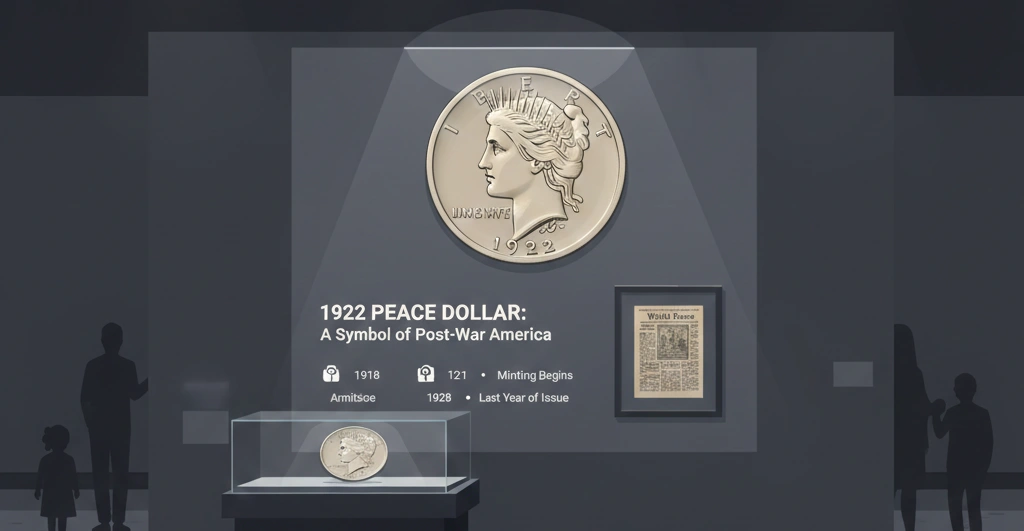
Mintage of the 1922 Peace Dollar marks the first year of mass production for this series featuring a low-relief design.
Technical difficulties encountered during mass manufacturing forced a transition from the 1921 high relief to the 1922 low relief.

Each coin consists of 90% silver and 10% copper, possessing a total weight of 26.73 grams.
Pure silver content in these specimens amounts to 0.77344 troy ounces.
Adapting the design for reducing die wear, Anthony de Francisci modified the original 1921 aesthetic.
This 1922 issue currently holds the record as the highest mintage in the history of the entire US silver dollar series.
Parameter | Value |
Composition | 90% Ag, 10% Cu |
Silver Weight | 24.05 g |
Diameter | 38.1 mm |
Thickness | 2.4 mm |
Designer | Anthony de Francisci |
Mints | Philadelphia, Denver, San Francisco |
The total production volume of 1922 exceeded 84 million specimens.
The mintage distribution between production facilities directly influences the modern value of specific mint marks.
Philadelphia (no mint mark) released 51,737,000 pieces, representing the absolute peak of the series.
Denver (D mark) struck 15,063,000 coins, demonstrating higher strike quality indicators relative to other mints.
San Francisco (S mark) produced 17,475,000 specimens, characterized by frequently encountered weak strikes on reverse details.
The presence of a massive market supply makes specimens in conditions below MS63 available at prices close to their melt value.
Pricing and Auction Records
The value of the 1922 Peace Dollar is determined by its grade on the Sheldon scale, confirmed by a PCGS or a free coin identifier app evaluation.
For specimens in MS60–MS63 condition, the price fluctuates between 35 and 55 USD.
A sharp value increase is recorded upon reaching MS66 grade and higher due to the geometric reduction in surviving samples.
The record price for a 1922 dollar in MS67 condition was recorded at 41,400 USD.
In comparison, a 1922-D coin in MS67 condition sold for an amount exceeding 20,000 USD.
Statistics show that the price gap between MS65 and MS67 exceeds 15,000% for this issue year.
Grade | 1922 (Philadelphia) | 1922-D (Denver) | 1922-S (San Francisco) |
MS63 | 45 | 55 | 60 |
MS64 | 65 | 90 | 120 |
MS65 | 150 | 350 | 600 |
MS66 | 600 | 2,500 | 4,500 |
MS67 | 15,000+ | 18,000+ | 25,000+ |
Correlation with Silver Prices
For uncertified 1922 coins, the silver spot price remains the primary value factor.
At a silver price of 25 USD per ounce, the intrinsic value of the coin is approximately 19.34 USD.
The market premium on ordinary specimens averages 40–60% over the melt value.
For investment purposes, purchasing 1922 coins in AU (Almost Uncirculated) condition is considered a low-risk entry into the asset.
A 10% drop in metal price usually leads to a 7–9% decrease in the value of raw coins.
However, for high-grade coins (MS65+), the correlation with silver prices is less than 0.10, indicating the dominance of numismatic factors.
Features and Minting Defects
The use of low-relief dies led to a loss of detail in Liberty’s hair and the eagle’s feathers.
In 1922, coins with defects caused by equipment wear are frequently encountered.
"Die polishing lines" are a common occurrence, reducing the aesthetic evaluation during grading.
Cases of striking on damaged planchets leading to lamination errors have also been recorded.
"Die Clash" errors for this year are valued by the market in the range of 50–100 USD per specimen.
Detecting unique minting errors requires using a coin checker app.
Return Dynamics Over a Ten-Year Period
Analyzing data for 2014–2024 allows for evaluating the asset's price growth rates.
2014–2017: Price stagnation at inflation levels with 1.5% annual growth.
2018–2021: Increased interest in silver resulting in a 25% price rise for MS64 coins.
2022–2024: A 10% price correction for top grades following the market entry of large private collections.
The average annual return for MS65 specimens over the last 10 years amounted to approximately 4.2%.
The liquidity of the 1922 dollar remains the highest in the Peace Dollar series due to constant demand across all price segments.
Comparison with the 1921 Issue
The 1922 dollar is often viewed as a budget alternative to the 1921 issue.
The 1921 mintage was only 1,006,473 specimens, being 83 times smaller than the 1922 mintage.
The price difference for a coin in comparable AU58 condition exceeds 400%.
Investors use the 1922 year for forming a silver position with minimal numismatic premium costs.
The technical difference in relief makes the 1922 year more resistant to physical wear during storage in tubes.
The transition to low relief ensured a more even metal distribution during the press strike.
Evaluation Criteria for Purchase
Acquiring a 1922 dollar requires checking three key zones on the coin.
The first zone is Liberty’s cheek, representing the highest point of the obverse and the first to receive contact damage.
The second zone is the feathers on the eagle’s wings, where a "soft strike" is often observed.
The third zone is the coin fields, which must lack deep scratches or signs of cleaning.
Coins showing signs of chemical cleaning lose up to 70% of their numismatic value.
The presence of original "cartwheel" luster is a mandatory requirement for an MS grade.
Utilizing slabbing guarantees protection against counterfeits, the number of which increases annually on the market.
The Role of VAM Varieties
The VAM (Van Allen-Mallis) catalog describes hundreds of die varieties for the 1922 issue.
Varieties with obvious defects or design changes are recognized as the most valuable.
For example, the 1922-P VAM-2F (die crack through the head) can cost 2–3 times more than a standard coin.
VAM identification requires deep knowledge of die topography and specialized literature.
For a beginning market participant, these varieties present difficulties in valuation and subsequent liquidation.
Statistics show that only 5% of collectors are willing to pay extra for rare VAM catalog numbers.
A low entry threshold is combined with high pricing transparency.
The massive volume of surviving specimens guarantees the possibility of acquiring the coin at any time.
The primary value of the asset lies in its precious metal content and the possibility of capitalization through grade appreciation.
A long-term strategy of holding MS64–MS65 coins has shown stable results over recent decades.
Careful selection of specimens with strong luster and minimal damage remains the key to capital preservation.